



 24 Nov
 Within the energy sector there are plenty of terms to get to grips with. As a business looking to save money on your energy bills, understanding what all these terms mean will help. One such term that you will almost certainly have come across will be EPC rating. In this latest article, we will be delving into exactly what EPC means and how this relates to businesses.
What is EPC?
An EPC or energy perform certificate is used to rate how energy efficient a building is. This is used for both domestic and commercial buildings. The ratings, as shown on the graph, are between A to G. A building with a rating of ‘A’ is considered the most efficient, and ‘G’ being the least efficient. An accredited assessor will provide an EPC certificate which is then valid for 10 years.
An EPC for a commercial building must be obtained whenever a property is built, sold or let. This is the responsibility of the building landlord or owner. So, if you are renting a commercial building, you will need to be shown the EPC certificate during the tenancy agreement process.
How an EPC is determined
As mentioned above, an accredited assessor will visit a property to determine the EPC rating. They will do this by taking into account a number of factors: The age and size of the property
The main heating systems
Lighting – whether any energy saving light bulbs or low energy light bulbs are in use
Windows – if you have double glazing or higher After reviewing these areas of the property, the assessor will make some calculations and provide an EPC rating using the scale mentioned above. Along with this, property owners or landlords will be provided with guidance on how to improve their property EPC if this is particularly poor.
There are some buildings that do not require an EPC according to the UK government, these include: Places of worship
Temporary buildings that will be used for less than 2 years
Stand-alone buildings with total useful floor space of less than 50 square metres
Industrial sites, workshops and non-residential agricultural buildings that do not use a lot of energy
Some buildings that are due to be demolished
Holiday accommodation that’s rented out for less than 4 months a year or is let under a licence to occupy
Listed buildings – you should get advice from your local authority conservation officer if the work would alter the building’s character
Residential buildings intended to be used less than 4 months a year Goals for a net zero future
With the government’s goals to achieve net zero emissions by 2050, the rules regarding EPC ratings are changing. Over the course of the next 10 years, these rules will become stricter for all. This is to encourage as many building owners and landlords as possible to make positive changes to the energy efficiency of their properties.
At the start of 2023, plans have been put in place for all commercial properties that are under tenancy to an EPC rating of E or better. As it stands this will require some landlords to make improvements now to meet the upcoming requirements.
How to Improve a Commercial EPC Rating
Landlords and commercial property owners can improve the EPC rating of a business premises by completing several tasks. Some of the most common and effective ways to do this are: To improve the insulation of the building
Change the lighting to LED lights
Ensure double glazing is installed in all windows
Draught proof the property
Switch to renewable energy sources such as solar panels For more about EPC ratings and how to save on your business energy, why not get in touch with a member of the D-ENERGi team. We’re here to help!
Read Article 21 Nov
 At D-ENERGi we work hard to provide all our business customers with the best business energy prices. We work closely with many care homes and residential homes across the UK, to keep them warm, dry, and well-lit while offering the best rates for business energy.
Throughout the upcoming winter season, care homes will be paying close attention to energy consumption, ensuring that while residents are cared for, bills are not too high. In this latest blog we will offer our best advice to any business customers looking to save on business energy.
Take control of your business energy with a smart meter
Smart meters are not just for domestic energy customers. Business energy meters are now available for businesses across the country to take full control of their business energy. Helping to manage usage and lower prices. Not only will you be able to track your usage, but the data a smart meter for businesses provides will be automatically sent to your energy supplier, so you can be sure your bills are as accurate as can be.
How to monitor your business energy consumption?
If you are concerned you may be using more energy than the average company in your care home, it may be time to consider installing a business energy smart meter.
As previously mentioned, a business energy smart meter will help you monitor your energy usage, reviewing your consumption, giving you a chance to better manage your energy usage. You may also wish to speak with your energy supplier if you believe your bills are too high. It is advisable to read your bills thoroughly when you receive them to be sure the information provided is correct. If you do not understand how to read an energy bill this blog may help you.
Ways to reduce your energy consumption
If you already have a smart meter installed in your care home and have noticed your energy consumption seems too high, here are some quick tips to help you better manage your energy consumption: Check the electrical appliances and the heating apparatus of your residential home to ensure these are working properly. Typically, newer appliances are far more economical.
Switch off electric equipment and tools when not in use. Although this may be difficult in a care home during winter, you may find there are many appliances that are regularly left running when not needed. This could include televisions, and radios.
Set a comfortable temperature on the thermostat and keep this regulated. Your residents will likely appreciate this also!
Create an energy saving culture amongst your employees. Encourage your care home staff to check thermostats regularly and switch off appliances between shifts.
Why not speak to a member of our team for other top tips! Talk to our experts today for competitive business energy quotes today!
Read Article 28 Oct
 1 – Energy efficient lighting will reduce your business electricity bills
One of the most important facts to consider about energy efficient lighting is that it helps businesses to save on lighting bills. By switching from traditional or halogen lighting in an office or other working space, businesses can save incredible amounts of energy. Here are just some of the best statistics: By switching a 75 watt incandescent light bulb to an LED light, companies could save up to £10 per bulb per year!
LED bulbs use up to 90% less energy than an old halogen bulb
Switching to energy efficient LED bulbs could help you lower your company’s carbon footprint
2 – LEDs are the most adaptable light fitting
LED light bulbs are the most adaptable type of energy efficient light fitting. They can be used in almost all settings and are the ideal solution for replacing traditional bulbs. LED light bulbs can be used for general lighting, outdoor lighting, spotlights, dimmable lights and in chandeliers. This also makes LEDs perfect for businesses in a wide range of industries requiring various levels of lighting in a number of environments.
3 – Companies can no longer produce halogen bulbs
Lighting manufacturers are actually no longer allowed to produce and sell halogen lights. This has helped to introduce the phase out of traditional inefficient lighting and instead encourage both companies and households to make the switch to energy efficient lighting like LEDs. Where you may find halogen bulbs is in places like ovens and security lights or in a store where old stock is being sold.
4 – Linear fluorescent lamps (LFLs) are most commonly used in offices
For large office spaces and warehouses, businesses can opt to use LFLs, these are modern strip lights that are capable of emitting a good amount of quality light. As opposed to traditional strip lights, which didn’t offer a good lifespan, LFLs are far more energy efficient and can help businesses save on their business electricity bills.
5 – Lighting accounts for around 20% of business energy consumption
Businesses may be shocked to discover that around 20% of their energy consumption comes from lighting. In order to keep usage low and costs down, now is the perfect time to reconsider the lighting solutions your business uses and switch to energy efficient lighting, either choosing LED lights or LFLs.
For more on business electricity rates and how to save your business money, read up on some of our other blogs with tips to help you cut down on your business energy consumption!
Read Article 26 Oct
 As energy costs continue to rise and we head into the coldest months of the year, we know just how important it is for businesses to keep costs low whilst being able to heat and run their business this winter.
Having control over your business’ energy consumption, paying close attention to your usage and keeping bills low, could help as we enter a difficult period of time economically. At D-ENERGi we are supporting businesses of all sizes, offering our advice to business energy customers in this time of much needed support. Here we have outlined some of our best advice for keeping energy consumption low in the business environment (particularly offices) throughout winter.
Reduce heating temperatures by just 1℃
Many will be preparing themselves for a cold winter and believing that it will feel even colder with managers switching heating systems off completely to curb the energy costs. Interestingly, however, this does not need to be the case. In the vast majority of cases, simply dropping the heating by only 1℃ can cut consumption by 8%! So, you don’t have to bundle up in coats and scarves while sitting at your desk.
Set timers to match your working hours
Plenty of businesses are guilty of using energy they don’t actually require. So many offices leave lights on overnight and devices plugged in 24/7. One way to reduce your business’ energy consumption is to simply set timers on your lighting and electrical devices so these are only connected when the office is in action. Heating and lighting should all be automatically set to turn off at the end of the day, the same time everyday.
For those who wish to work later into the day, you may wish to provide individuals with desk lamps to provide light to only where it is needed.
Aim for a comfortable working temperature
Although the outdoor temperature plummets into the winter months, there is no reason why the heating inside an office, particularly smaller offices, should exceed a comfortable temperature. In fact, the lowest comfortable working temperature is between 18–21℃ depending on the workplace. As mentioned above, dropping your thermostat down just a few degrees will cut energy consumption by a large amount. It is also important to note that warmth in offices doesn’t just come from the heating system but also the lights, the many people and other devices that are running continuously.
Upgrade your lighting to LED lights
A big expense for business energy customers is outdated lighting. If possible, and within budget, an upgrade to LED lights will help lower your energy costs. LED bulbs are far more energy efficient than standard incandescent bulbs and will last much longer. LED lights provide businesses low-maintenance, low cost lighting that does the job and is the more sustainable option!
Consider installing a business smart meter
A great way for businesses to keep on top of their business energy consumption, monitoring usage, is to install a business smart meter. At D-ENERGi we offer business smart meters to our customers, no matter what industry you are in. If you are an energy-conscious business, or simply seeking ways to save your business money, the benefits of a business energy smart meter should not be underestimated. To find out more, why not get in touch with us and arrange a business smart meter install today!
Read Article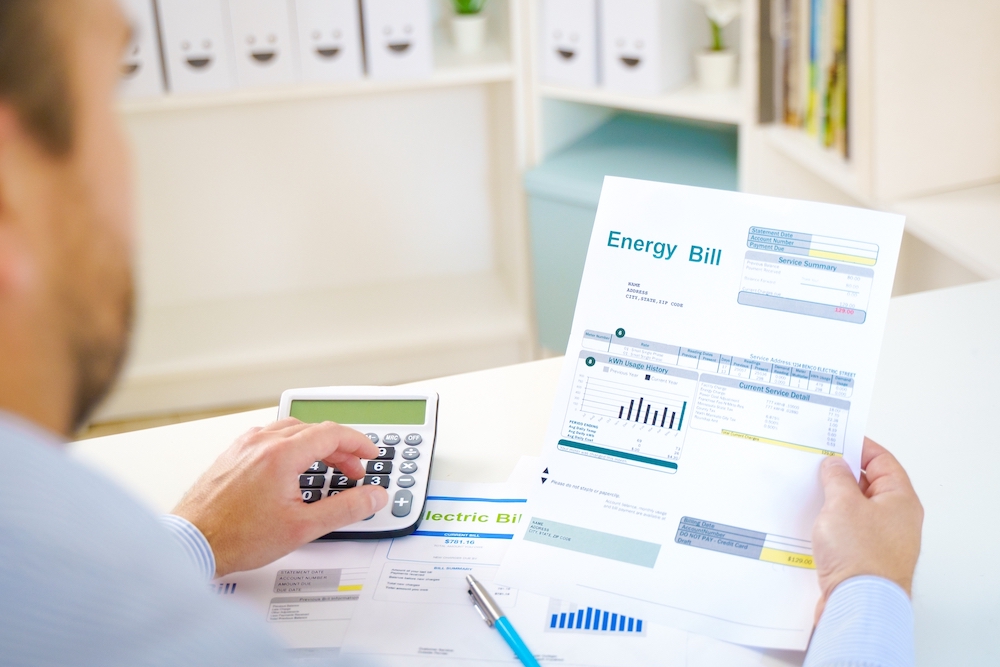 20 Oct
 Whenever you receive an energy bill, whether that is by post or via email, it may be tempting to put this to one side and ignore it. However, it is incredibly important to read your business energy bills when you receive them. This will help you to understand your energy usage and how your energy supplier has calculated your costs.
Our quick guide provides all the details you need to decipher your business energy bill and use this to your advantage.
How to break down your bill
Receiving a letter with numbers across the page, graphs and more, can make understanding your energy bill confusing. But, it doesn’t have to be. Being able to break down each section of your bill will simplify the information you have been provided. Bills will look slightly different, depending on who your supplier is. However, the majority of energy bills will display the following information in some format.
Your usage period – this will be a date range, indicating what period of time this bill is for. Usually this will be between several months.
The amount required – The total amount will be shown clearly on the page, this is the figure that you owe your energy supplier.
Your energy consumption – Your energy bill will typically display the amount of energy you have consumed during this period. This will be measured in kilowatt hours (kWh).
Your meter readings – If you were providing your energy supplier with regular meter readings during this period, they will display your actual meter readings. If this was not the case they will display their estimated meter readings based on previous energy consumption. Your meter serial number must also be shown here, so be sure to check this is correct.
A breakdown of your bill – this will usually be included in your bill to further explain the figure you owe.
When you first receive your bill, you should read it through thoroughly and identify each of these key sections. If there is anything missing or information that you do not believe to be accurate, it is important that you get in contact with your energy supplier who can further explain this. If the meter serial number shown on your bill is incorrect, you must identify this immediately and let your supplier know, as they could be retrieving data from the wrong meter and making poor estimations.
Read Article 13 Oct
 Setting up your utilities is an important step in the early stages of your business. By doing this early on, you will be able to conduct forecasting, allowing you to budget for the forthcoming year. If you have never owned or run your own business before, you may be slightly unsure as to how setting up business utilities will differ from your own personal utilities. In this guide we explain everything you need to know, so you can get started making money and growing your business.
Identify your necessary utilities
The first step in the process is quite simple, but will help you to prioritise which utilities you should be setting up first. For example, water, gas, and electricity, will be three of the most essential utilities you will need to set up before you can start running your business. Broadband and telephone connections will also be required to help get you connected to your customers or clients.
Choosing a business utilities supplier
Once you have identified your essential business utilities, now it is time to find suitable suppliers for each. There are some key things to bear in mind when finding the right utilities supplier for your business, these include: Your budget
Your projected usage
What payment options are available and which would suit you best
Check contract lengths How to pay the best rates for your business utilities
Some of the most common ways to find the cheapest rates for your business is to use price comparison sites or to access the information of a broker. Although, the point should be raised, those who opt to go through these third-party services must be cautious. Read all the information provided before agreeing to sign any contract and be sure you understand what you are signing up for.
With energy rates currently at an all time high, it may be useful to refer to information provided by Ofgem who is the government regulator for the electricity in Great Britain.
For water in the UK you will have to pay for any water that your business uses and the liquid waste produced from your premises. Ofwat is the regulator for the water sector in England and Wales.
D-ENERGi Business Energy
At D-Energi, we make it simple for businesses from a range of sectors to access competitive prices and rates for business energy in the UK. Our services include business electricity, business gas, business water, half hourly electricity and more. To get quotes for your new business, contact our friendly team today.
Read Article
Get the Best Business Energy Quotes
Price Match Available: Our price matching team will provide you the most competitive business energy rates. We won’t just match your current energy quote – we’ll strive to beat it!
Join thousands of UK businesses that have already started saving on their business energy costs!
Sign Up For The Latest News and Insights on Market Trends
"*" indicates required fields