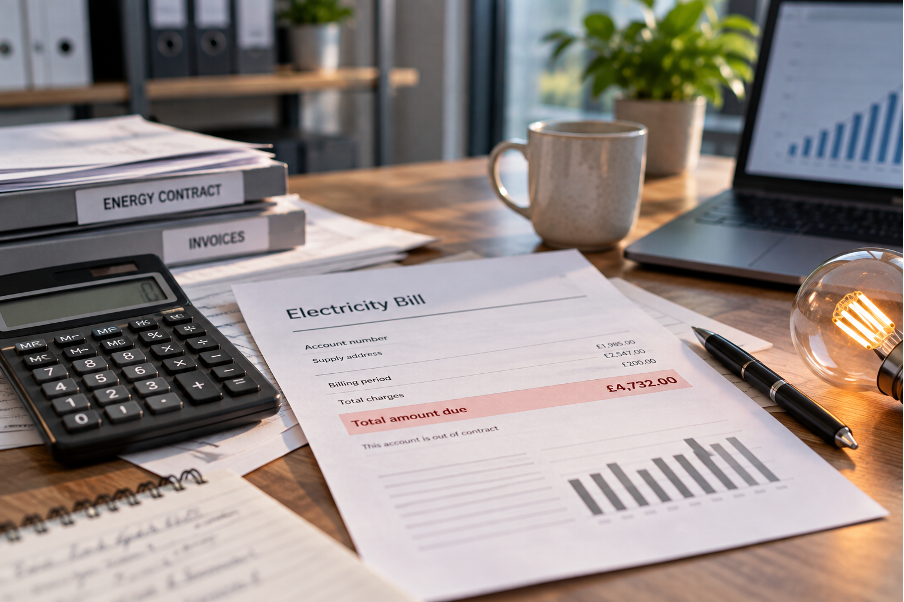
Out-of-Contract & Deemed Rates | Why They Cost So Much
Require Assistance?
If you are seeking guidance on how to effectively reduce your business electricity and gas costs, or require assistance with a business energy switch, please call our dedicated Customer Services team at 0800 781 7626. We assure you that calls will be answered promptly within three rings or less!
Quick summary: Out-of-Contract & Deemed Rates are temporary business energy prices that usually cost considerably more than a properly arranged contract, so businesses should move onto an agreed tariff as quickly as possible.
What are out-of-contract rates?
Out-of-contract rates are the prices a supplier charges when a business energy contract has ended, but the customer has continued using gas or electricity without agreeing to a replacement contract.
They are designed to keep the supply running when no new agreement is in place. That is useful in the short term from a continuity point of view, because the lights do not suddenly go off when a fixed contract expires. The downside is that the rates can be significantly higher than those available under a negotiated contract.
For businesses with meaningful energy consumption, even a relatively short spell on an out-of-contract tariff can create an unpleasant jump in monthly costs.
When out-of-contract rates apply
The most common trigger is a contract reaching its end date without a new deal being arranged. You may have missed a renewal reminder, delayed making a decision or assumed the existing contract would simply continue on similar terms.
Instead, once the fixed agreement ends, the supplier may move the account onto its published out-of-contract tariff. These prices normally remain in place until you agree to a new contract, move supplier or otherwise change the arrangement covering the site.
How suppliers set out-of-contract pricing
Unlike a fixed-term contract, where pricing is agreed for a defined period, out-of-contract prices are usually set by the supplier and can be amended under its terms.
The supplier must account for wholesale energy costs, network and policy charges, operational costs, and the extra uncertainty of supplying a customer who is not committed for a fixed period. That uncertainty is one reason these rates tend to carry a noticeable premium.
What are deemed rates?
Deemed rates apply when a business is consuming energy at a property but has not actively agreed to a contract with the supplier currently serving that site.
A deemed contract exists automatically in certain circumstances. It means the business can use gas or electricity legally and continuously during account deliberation, but the tariff attached to that supply is rarely the most economical long-term option.
When deemed rates apply (new tenancies, moving in)
The classic example is moving into new business premises. The property already has an energy supplier, and from the moment you take responsibility for the site and start consuming energy, you may be supplied under deemed terms until you arrange your own contract.
This can also happen after a change of occupier when the incoming business has not contacted the existing supplier straight away. The longer the delay, the longer deemed pricing can continue.
How deemed rates are calculated
The supplier currently providing energy to the premises sets deemed tariffs. Charges can include a unit rate for the energy consumed and a standing charge, with exact pricing depending on the supplier, fuel type, meter, and account circumstances.
Because there is no fixed-term commitment and the supplier has limited certainty about how long the customer will remain, deemed prices can be much higher than contracted rates.
Out-of-contract vs deemed rates | Key differences
The two terms are often used together because both can result in expensive business energy bills. However, they arise for different reasons.
| Factor | Out-of-contract rates | Deemed rates |
| Why they apply | An existing contract has expired | No contract has been agreed by the current occupier |
| Typical situation | A business misses its renewal window | A business moves into new premises |
| Supplier relationship | Usually the same supplier from the previous contract | Usually the supplier already serving the property |
| Price level | Commonly higher than contracted rates | Commonly higher than contracted rates |
| Contract commitment | No new fixed-term agreement is in place | No actively negotiated agreement is in place |
| Best response | Arrange a new contract promptly | Contact the current supplier and arrange suitable contracted terms promptly |
Why these rates cost so much more
The higher cost is not simply a penalty for forgetting to renew. It reflects how suppliers price the additional uncertainty involved when there is no fixed-term agreement. Why would they give you the best rate if they can’t trust that they’ll be setting a fresh contract?
No competitive tension or negotiated pricing
When you actively arrange a contract, the price is based on a defined term, expected consumption and a clear start date. That allows you to assess the available options and choose an arrangement suited to your business.
On out-of-contract or deemed terms, you are effectively accepting a supplier’s default pricing. No newly agreed deal shapes the rate, which can leave you paying much more than necessary.
Higher risk premiums built in by suppliers
Suppliers value certainty. A fixed-term contract provides a clearer picture of expected demand and how long the customer is likely to stay.
With deemed or out-of-contract customers, that certainty disappears. The business could arrange a new deal and leave at relatively short notice. Suppliers therefore build additional risk into their default pricing, reflected in higher unit rates and, in some cases, higher standing charges.
No fixed-term protection from market volatility
A fixed contract protects clients from changes in wholesale energy pricing for the agreed period, depending on the product and contract structure. Default rates do not offer the same certainty. Prices may be reviewed or changed by the supplier, which means a business can be exposed to both an already expensive tariff and further market movement.
How businesses end up on out-of-contract or deemed rates
Most businesses do not deliberately choose these tariffs. They usually land on them because of timing, admin gaps or a change in circumstances.
Missed renewal deadlines
Energy contracts can sit in the background for years, so renewal dates are easy to overlook. If responsibility changes internally, reminders go to an old email address or the business leaves the decision until the final moment, the contract can expire before a replacement is arranged.
Moving into new premises without a contract in place
When relocating, energy can be overshadowed by leases, removals, IT, staffing and fit-out work. Yet the meter starts recording consumption from the moment the business takes responsibility for the property.
If no new energy agreement is in place, deemed rates can begin immediately. Taking meter readings and contacting the incumbent supplier on or before the move-in date can prevent confusion over both billing and responsibility.
Supplier of last resort situations
If an energy supplier exits the market, affected customers may be transferred to another supplier through industry arrangements designed to protect continuity of supply. The terms that apply after a transfer can differ from the business’s previous contract.
In that situation, it is worth checking the new account details carefully and understanding what tariff you have been placed on before deciding what to do next.
The real cost | Example price comparisons
The actual premium varies by supplier, market conditions, meter and contract type, so no single percentage applies to every business. What matters is the gap between your current default rate and the price you could secure under a suitable contract.
Typical out-of-contract rate premiums
Imagine a business uses 100,000 kWh of electricity a year. If its out-of-contract unit rate were 8p per kWh higher than an available contracted rate, the difference would be £8,000 a year before any variation in standing charges or other costs.
Even a smaller 4p gap would equate to £4,000 across the same level of consumption. This is why it is worth acting quickly rather than assuming a few months on default pricing will make little difference.
How quickly costs add up over a few months
Using that same 100,000 kWh annual consumption, an 8p unit-rate difference works out at roughly £667 extra per month if usage is spread evenly through the year.
Three months could therefore add around £2,000 in extra energy cost. For higher-consuming sites, multi-site organisations or businesses with seasonal peaks, the financial impact can be much larger.
How to get off out-of-contract or deemed rates
There’s no reason to stay on these tariffs long term. After you establish exactly what arrangement you are currently on and gather the right information, you can move onto suitable contracted terms as efficiently as possible.
Gathering your site and usage details
Start with a recent bill. You will usually need your business address, meter details, current supplier, annual or estimated consumption and information about the existing tariff.
If you have just moved into the property, take dated meter readings and keep evidence of when you took responsibility for the premises. This helps the supplier set the account up correctly and reduces the risk of being billed for a previous occupier’s usage.
Comparing the market quickly
Once you know your consumption and current position, assess the contract options available for your business. Look beyond the headline unit rate and consider standing charges, contract length, payment terms, pricing structure and any conditions that could affect the overall cost.
The aim is not to rush into the first offer purely because your current tariff is expensive. It is to move promptly while still making a commercially sensible decision.
Timing the switch to minimise exposure
Every extra day on a high default rate can add cost, so speed matters. Ask when a new contract can begin, whether any notice is required, and whether administrative issues could delay the change.
For deemed customers, contacting the existing supplier quickly is especially important because it confirms who is responsible for the account and creates a clear starting point for arranging new terms.
How to avoid them in the future
Good contract management is the simplest defence. Record every energy contract end date in a central calendar and set reminders well in advance rather than relying on a single supplier notification.
Keep renewal responsibility clearly assigned, keep contact information up to date, and review your usage before the renewal window opens. If you are planning a move, add energy to the relocation checklist alongside broadband, insurance and business rates.
It also helps to keep copies of contracts, recent bills, meter references and consumption data in one place. When the time comes to review your supply, you can act immediately instead of losing days searching for basic account information.
How D-ENERGi can help you get back on a competitive rate
If your business has fallen into deemed or out-of-contract pricing, D-ENERGi can help you understand your current position and arrange a business energy contract that better reflects your requirements.
That starts with reviewing the site, meter, and consumption information, then identifying suitable contract options and helping you move away from expensive default pricing as efficiently as possible.
The same approach can also help prevent the issue from recurring. By keeping on top of contract dates and reviewing your options before an agreement expires, you have more control over both timing and cost.
Conclusion
Out-of-contract and deemed rates exist to keep business energy supplies running when no active negotiated contract is in place. They are useful as a temporary safety net, but they can be a costly place to stay.
Whether your previous contract has expired or you have just moved into a new property, the key is to identify your tariff quickly, gather your account details and arrange appropriate contracted terms. A few days of admin today could prevent months of unnecessary energy spent.
For more detailed breakdowns of business energy topics across the industry, visit our blog. It’s just another space where we offer assistance for businesses looking to navigate this increasingly complex landscape.
Frequently Asked Questions (FAQs)
Why is my business energy bill suddenly so expensive?
If a fixed-term contract has recently ended, you may have been moved onto an out-of-contract tariff. If you have recently occupied new premises, you may be paying deemed rates. Check the tariff name, unit rate and standing charge on your latest bill and contact the supplier if anything is unclear.
What is the difference between deemed and out-of-contract rates?
Out-of-contract rates generally apply after an existing business energy contract expires without a replacement being agreed. Deemed rates usually apply when a business uses energy at premises without having actively agreed a contract, such as after moving into a new property.
How much more expensive are out-of-contract energy rates?
There is no universal premium. The difference depends on the supplier, market conditions, meter type and the contracted rates available at the time. For a high-consuming business, however, even a few pence extra per kWh can translate into thousands of pounds over a year.
Can I negotiate my way off a deemed rate?
You can usually arrange a new contract rather than remaining on deemed terms indefinitely, subject to the supplier’s processes and the circumstances of the account. Start by confirming responsibility for the premises, providing meter details and readings, and asking what contracted options are available.
How quickly can I switch off an out-of-contract rate?
Timescales vary. They can depend on your current supplier, the new contract start date, notice requirements, account status and whether any meter or transfer issues need resolving. The key is to start the process immediately to keep exposure to the higher rate as short as possible.
What should I do when moving into new business premises?
Take meter readings on the day you become responsible for the property, photograph the meters if possible and contact the existing energy supplier promptly. Give them the move-in date, business details, and readings, then arrange suitable contracted terms rather than letting deemed pricing continue longer than necessary.